The Increasing Average Age of the Workforce: What the Data Really Shows
The Increasing Average Age of the Workforce: What the Data Really Shows
Here's a number that might surprise you: the average age of a new hire in 2025 was 42 years old. Up from 40 in 2016. That's according to workforce analytics firm Revelio Labs, and it tells a story that goes well beyond a simple demographic shift.
The workforce isn't just getting older because the population is ageing. It's getting older because economic conditions have fundamentally changed who gets hired, when, and for what.

Two forces pulling in opposite directions
Revelio Labs' analysis makes the mechanics clear. Two things are happening simultaneously: fewer young workers are entering the labour market, and fewer older workers are leaving it.

The share of workers under 25 in new positions has been declining steadily since the mid-2010s, falling from around 16% to single digits by 2025. Over the same period, the share of workers aged 65 and older entering new roles has risen sharply, particularly after 2022.
As Revelio Labs' chief economist Lisa Simon explained, this is the opposite of what typically happens during a strong economy when tight labour markets usually pull younger workers into new roles. Instead, the current cycle shows a market tilted toward experience.
It's not just demographics — it's economics
This distinction matters. A common assumption is that the workforce is ageing simply because the population is getting older. But Revelio Labs' decomposition of the data shows something more interesting: nearly the entire increase in average workforce age comes from ageing within occupations, not from the economy creating new jobs that inherently skew older.
In plain terms: the same jobs are being filled by older workers than before. It's not that new "senior" roles are appearing — it's that employers are preferring experience over potential when making hiring decisions.
"Entry-level hiring has weakened across much of the economy, while older workers have become more willing to stay in the labour force or return after retirement." — Revelio Labs
When economic growth slows, hiring doesn't disappear — it becomes more conservative. Immediate productivity, role readiness, and experience suddenly matter more than training potential. That makes older workers comparatively attractive.
Where older workers are landing
The data is specific about which roles are skewing older. Workers over 65 are disproportionately entering positions in sales, strategy, community-facing, and teaching roles. Sales representatives in particular stand out, with workers over 65 overrepresented by more than ten percentage points relative to other age groups.
These are roles that reward credibility, judgment, and networks — qualities that compound over a career. They also often offer flexible arrangements that make re-entry more appealing later in life.
Customer-facing roles more broadly have seen average ages rise notably. The average age of workers in sales, real estate, and office support has climbed by approximately two and a half years since 2015.
The global picture: 150 million jobs shifting
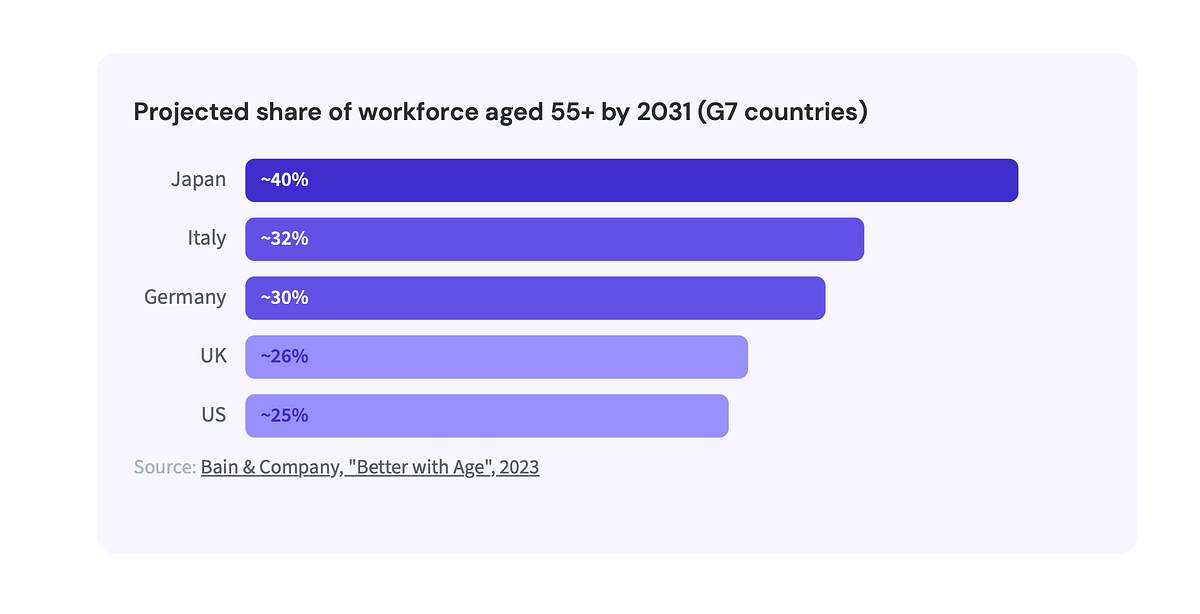
This isn't limited to one country. Bain & Company projects that 150 million jobs globally will shift to workers over 55 by 2030. In the G7, workers aged 55+ will exceed 25% of the workforce by 2031. Japan leads at nearly 40%. Italy and Germany are at around 30%. The US is tracking toward 25%.

What this means if you're considering going back
If you're over 50, 60, or even 65 and thinking about returning to work, the data is firmly on your side. Employers are hiring older workers at higher rates than at any point in modern history. The roles that reward experience — sales, customer service, community-facing, strategy, and teaching — are actively seeking people with your profile.
The workforce isn't moving away from you. It's moving toward you.
Are you considering moving into employment again? See our job listings via following link: https://semiretired.co.uk/jobs